


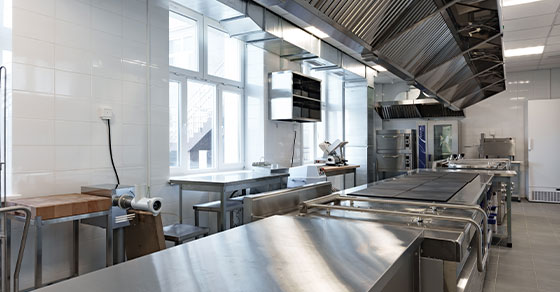
Picture this scenario: A failed health inspection starts with a surface that looked fine, but wasn’t. This could be a hairline crack in a laminate counter or wood base that swelled after one too many washdowns.
For facility managers weighing countertop materials, the ideal question is which one survives daily contact with chemicals, heat, moisture, and constant use without becoming a liability. Below, we take a closer look at this question, and why it is a go-to for industrial facilities.
What Goes Into a Stainless Steel Countertop Built for Industrial Use
It is important to note that not every metal surface marketed as “industrial” is built for the required conditions. The difference comes down to specification, not appearance.
- Gauge thickness, for instance, determines how well a surface resists denting under daily impact.
- The substrate underneath matters just as much. A properly reinforced base prevents flexing and seam separation over time, while a weak one leads to warping long before the surface should fail.
- Grade selection tends to factor in, too. Standard 304 stainless steel handles general processing environments well. In contrast, the 316 includes added resistance for facilities dealing with salt, acid, or aggressive sanitizing chemicals.
- Weld quality finishes the picture, since a poorly finished seam can undo every other advantage.
In essence, stainless steel countertops are only as good as the engineering behind them. So, what does that engineering deliver once a facility puts it to work?
Why is stainless steel the first choice for industrial applications?
Engineering choices translate directly into operational outcomes. Once the gauge, grade, and welfare are right, the surface starts working for the facility instead of against it. Five advantages explain why this material consistently outperforms alternatives in demanding environments.
1. Corrosion and chemical resistance
Stainless steel forms a thin, self-healing layer of chromium oxide on its surface. This layer is what stops rust before it starts, and it regenerates itself even after scratches or abrasion expose fresh metal underneath. For facilities running daily degreasers, sanitizers, or industrial solvents, this matters more than most buyers realize.
A counter that only resists food acid will eventually pit or discolour when exposed to harsher cleaning agents. Properly graded stainless steel handles both without flinching, hence why it remains the standard surface in processing environments where chemical exposure is routine.
2. Measurable hygiene
Every supplier claims that their surface is easy to clean, but few can prove it. Stainless steel earns its hygienic reputation in two ways.
- First, it’s non-porous. This means it has no tiny holes where bacteria can hide, unlike wood or some plastics.
- Second, manufacturers can measure how smooth the surface is using a number called Ra, short for roughness average. The lower the number, the smoother the ride and the fewer the microscopic groves for residue to collect in.
This is why standards like NSF/ANSI 51, and guidance aligned with Canada’s CFIA expectations, focus on finish quality and weld integrity.
3. Structural durability under daily load
Industrial countertops absorb more abuse in a single shift than most residential surfaces see in years. For example:
- Bins get dragged across them.
- Totes get dropped.
- Equipment shifts from a hot processing line to a cold storage area within the same day.
All the above put the surface through repeated thermal cycling. During periods of high production volume, this kind of stress happens constantly. A proper stainless steel surface absorbs these conditions without warping, cracking, or losing structural integrity.
4. Long service life
A well-built surface can last fifteen to twenty years or more under regular industrial use. Cheaper alternatives usually need replacement every few years once moisture, heat, or impact takes its toll. When facility managers compare commercial stainless steel countertops against materials that need frequent repair or new change, the upfront price difference tends to be less significant. While every case is unique, the math favours steel when downtime, repair labour, and replacement frequency enter the equation.
5. Adaptability across facility types
A surface that performs well in a food processing plant should perform just as well in a warehouse, manufacturing facility, or pharmaceutical-adjacent environment.
Stainless steel adapts across all of these settings without the need for a different material for each once. Such versatility simplifies procurement for facilities that run different operation types under one roof.
Stainless Steel Countertops vs. the Alternatives: Laminate, Butcher Block, and Solid Surface
Laminate wins on upfront price and little else in an industrial setting. Moisture works its way under seams over time, heat from industrial kitchen equipment can warp the surface, and a single hard impact leaves permanent damage.
Butcher block and wood composite surfaces bring a different problem entirely. Wood is porous by nature, which means it absorbs moisture and can harbour bacteria deep within the grain (regardless of how often it gets sealed).
Solid surface materials, such as the Corian-style countertops common in commercial settings, perform better than both. However, it still carries limitations like scorching under direct heat and etching when exposed to strong industrial chemicals. The damage repair usually leads to the call-in of a specialist rather than handling it on-site.
Stainless steel countertops avoid all three failure points at once:
- No seams to compromise.
- The porous surface eliminates harbour contamination.
- Zero vulnerability to heat or chemical etching.
Realizing that value, though, depends entirely on buying the right specification in the first place.
What to Look Out for Before You Buy
Specification is where a good decision either holds up or falls apart.
- Before committing to a supplier, confirm that the gauge thickness and grade match the facility’s real exposure. This could entail chemical contact, salt, or heavy daily loads.
- Ask for mill test certificates or material traceability documentation. Both can confirm exactly what alloy is being delivered rather than reliance on verbal assurance.
- Pay close attention to weld quality and surface finish quality as well. Sloppy or unground welds have proven to be the leading cause of hygiene failures in commercial stainless steel countertops.
- Lastly, insist on fabrication built to the facility’s dimensions instead of generic prefabricated sizing.
Getting these details right is exactly where the choice of fabrication partner becomes the deciding factor.
Why Facilities Across Canada Choose Nu-Tech Metals Fabrication
Nu-Tech Metals Ltd. is a metal fabrication company, manufacturer, and supplier serving clients across Eastern and Western Canada. Our expertise spans custom steel buildings, stainless steel countertops, and heavy-duty steel components.
All our steel buildings are engineered to handle all circumstances, including wind load, heavy snow, and extreme cold. Structural frames are designed to resist bending and fatigue even after years of exposure.
Interior and exterior panels are also prioritized. Each exterior production receives treatment to resist rust and corrosion. This ensures every structure holds up through the harsh and unpredictable Canadian winters. Interiors can be made to match each facility’s needs, like sheeting, insulation, or wood panelling.
The same precision carries into our fabrication of industrial kitchen equipment and custom work surfaces. Every unit is built to the exact specifications that each operation needs.
Reach out today at +1 807-798-1127 or contact us online to speak with one of our custom fabricator specialists, request a quote, or book a consultation.

